

Question 2
D ) All of the above
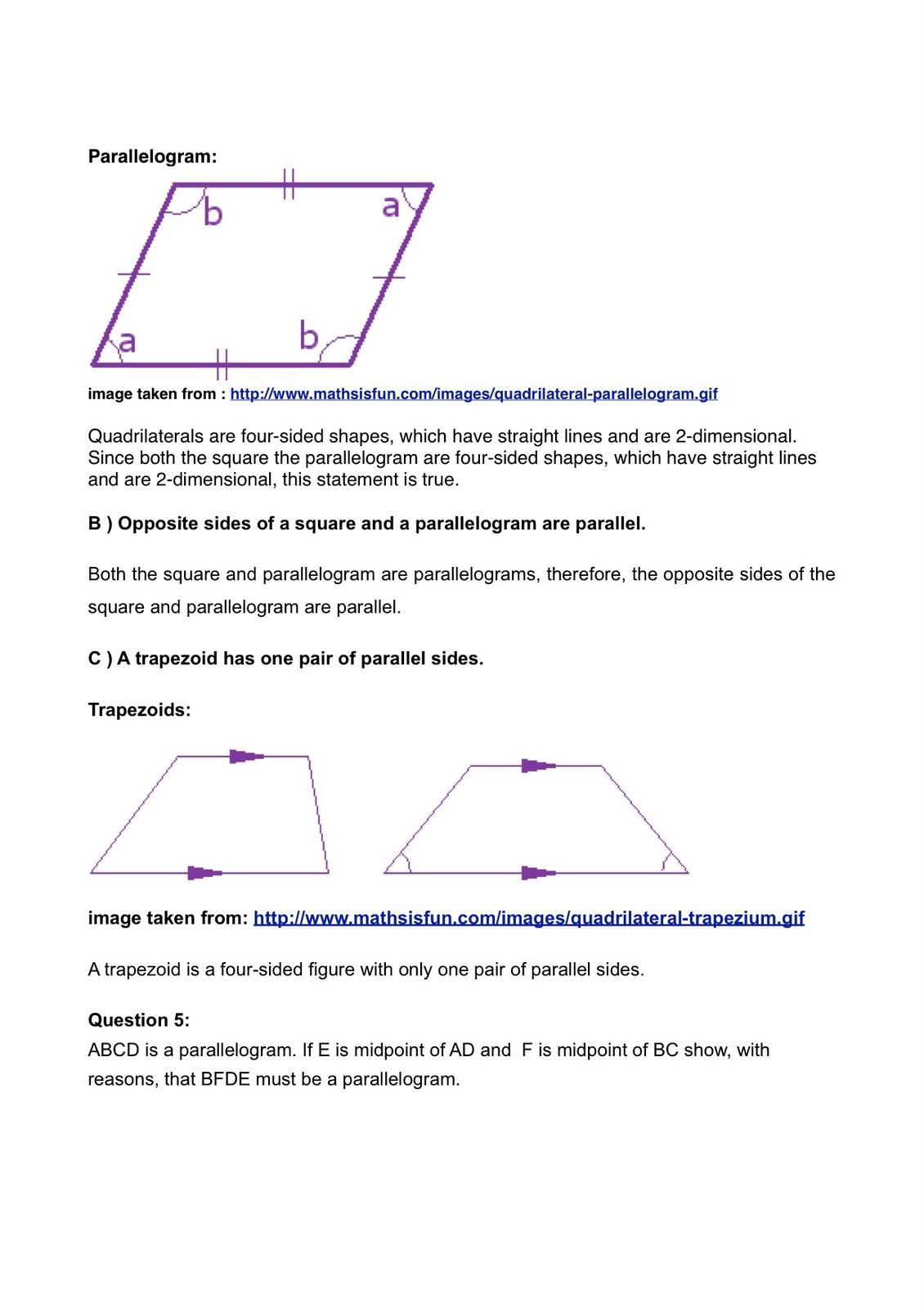
Both squares and parallelograms are quadrilaterals as they both have four sides.
Both the squares' and the parallelograms' opposite sides are parallel as the other two sides are of equal length.
A trapezoid has a pair of parallel sides as it is made out of a rectangle and a triangle and a rectangle has a pair of parallel sides.
Question 4
I do not agree with the statement. A parallelogram cannot be a square as all corners of the square must be 90 degrees and all of the sides must be equal.
A rhombus is a quadrilateral whose four sides all have the
same length.
However, a square has four equal sides and four equal right
angles at the corners.
If a square is turned into a rhombus, it loses its four
right angle corners. Therefore, it cannot be counted as a
square. However, if the rhombus is turned into a square, it
retains its length and still counts as a rhombus.
Question 2:
Which of the given statements is correct? Justify your
answers with examples.
A ) A square and a parallelogram are quadrilaterals.
Correct, because a square has 4 sides and 4 corners, and so
does a parallelogram.
B ) Opposite sides of a square and a parallelogram are
parallel.
For the square, it is correct as 4 corners are supposed to
be 90°.
For the parallelogram, it is also correct because even
though it does not have 4 equal angles, it still has 2 sets
of parallel lines.
href='http://img269.imageshack.us/i/trapezium.png/'><img
src='http://img269.imageshack.us/img269/5461/trapezium.png'
border='0'/></a>
C ) A trapezoid has one pair of parallel sides.
Correct as well, refer to diagram below.
href='http://img237.imageshack.us/i/squareparallelogram.png/'><img
src='http://img237.imageshack.us/img237/9694/squareparallelogram.png'
border='0'/></a>
D ) All the above
Question 4
"All parallelograms are squares?" Do you agree with this
statement?
I do not agree with this statement. A parallelogram refers
to a figure with 2 sets of parallel lines. However, a square
has 2 sets of parallel lines, 4 sides of the same length AND
must have the corner angles equal to 90° each. A rectangle
has 2 sets of parallel lines. However, it does not have 4
equal sides. Another example is a rhombus. A rhombus has 2
sets of parallel lines. However, it again does not have 4
corner angles, making it not qualify as a square.

My answer would be No as Parallelograms are squares only if all four sides are of the same length and all interior angles are 90o.

Question for discussion
Based on the above conversation discuss, with examples and justification whether the following statement is justified.
'A square is a rhombus but a rhombus is not a square'.
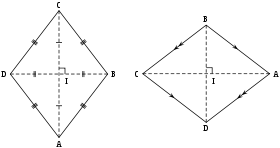
A rhombus is a quadrilateral whose four sides are all congruent.
A square is a quadrilateral whose four sides are all congruent and whose angles are all right angles.
In other words, a square is a rhombus that is also a rectangle.
The above two quadrilateral are both rhombuses but the four sided, with vertex of 90 degrees is a square, not a rhombus:


